

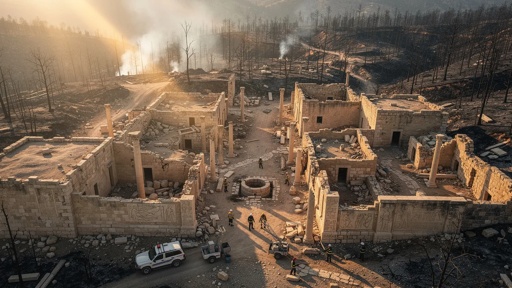
Archaeologists claim to have uncovered biblical Bethsaida, the hometown of Jesus’s apostles Peter, Andrew, and Philip, after a 2025 wildfire exposed ancient mounds at Israel’s el-Araj site—potentially validating Scripture’s historical accuracy and reshaping our understanding of where Christ performed His most famous miracles.
Wildfire Exposes Ancient Village Hidden for Centuries
In late July 2025, a destructive wildfire swept through Israel’s Betiha Nature Reserve along the Sea of Galilee’s northern shore, burning away dense vegetation that had obscured the el-Araj archaeological site for generations. Rather than destroying history, the fire revealed what may be one of Christianity’s most significant locations: hundreds of earthen mounds scattered across charred terrain, each potentially marking an ancient residential structure. Archaeologists immediately recognized the opportunity to examine areas previously inaccessible beneath overgrowth.
Connecting Scripture to Physical Evidence
Bethsaida, meaning “house of fishing” in Hebrew, holds profound significance in the New Testament as the hometown of apostles Peter, Andrew, and Philip. The Gospel accounts describe Jesus performing multiple miracles near this village: feeding the 5,000, walking on water, and healing a blind man. For decades, scholars debated whether et-Tell or el-Araj represented the true biblical site. El-Araj’s location directly on the Sea of Galilee’s shore and its 1st-century Roman-era artifacts—fishing tools, bathhouse structures, and Jewish limestone vessels—align far more closely with Gospel descriptions than et-Tell’s inland, Iron Age-focused remains.
The Peter Inscription: Direct Link to Apostolic Authority
In 2022, excavators uncovered an inscription in an early church layer referencing the “keeper of the keys”—a biblical reference directly tied to Peter’s authority in Matthew 16:19. This discovery provided tangible evidence connecting the site to one of Christianity’s foundational figures. Combined with the wildfire’s recent exposure of residential mounds, the inscription strengthens the case that el-Araj was not merely a fishing village but a place where early Christians deliberately built commemorative structures over apostolic homes, a practice documented at other holy sites.
Ongoing Excavations Target Roman Urban Layer
As of 2025, the ninth season of excavations at el-Araj continues with renewed focus on uncovering the 1st-century Roman urban layer beneath Byzantine and Crusader remains. Archaeologist Mordechai Aviam stated that the wildfire’s charred terrain revealed “hundreds of meters dotted with earthen mounds, each potentially marking an ancient room,” providing roadmaps for targeted trenching. Excavators have already recovered pottery, bathhouse evidence, and ritual items confirming Jewish occupation during Jesus’s ministry period, though no structures have yet been fully exposed—the work remains painstaking and ongoing.
Biblical Archaeology Validates Scripture’s Historical Claims
This discovery carries profound implications for biblical historicity. Conservative scholars have long maintained that Scripture’s geographical and cultural details reflect genuine historical memory rather than fabrication. The el-Araj findings—including 1st-century fishing implements, Roman-era construction, and early Christian veneration markers—provide archaeological corroboration for Gospel accounts. Such validation strengthens confidence in Scripture’s reliability on matters of history and geography, a concern for believers seeking to understand the factual foundation of their faith.
The long-lost biblical village where Jesus performed miracles is 'found' by archaeologists – Daily Star https://t.co/9CWmN9PhRY
— KylemcroreyOwner (@KylemcroreyO) May 12, 2026
Implications for Christian Heritage and Tourism
The confirmation of Bethsaida’s location at el-Araj reshapes Christian pilgrimage and biblical tourism across the Sea of Galilee region. For centuries, pilgrims have visited holy sites seeking tangible connections to Jesus’s ministry. This discovery offers concrete archaeological evidence that these locations are historically grounded, not merely pious traditions. The findings also reinforce Israel’s role as custodian of Judeo-Christian heritage, strengthening interfaith dialogue between Christian and Jewish communities united in preserving biblical history.
Sources:
Wildfires Unveil Lost Biblical Bethsaida, Where Jesus Performed Miracles
Archaeology Breakthrough: Long-Lost Site of Jesus’s Miracles Found
Long-Lost Site Where Jesus Performed Miracle Found After Wildfire