

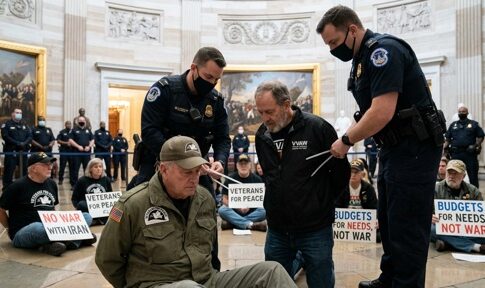
Disabled US military veterans in fatigues were zip-tied and arrested by Capitol Police for protesting President Trump’s Iran war inside Congress, exposing deep rifts even among those who served.
Protest Details and Symbolism
Approximately 60 US military veterans and family members assembled in the Cannon House Office Building rotunda on April 20. Many wore military fatigues, with some visibly disabled. They conducted a flag-folding ceremony to honor fallen US troops lost in the war initiated by President Trump and Israeli Prime Minister Netanyahu on February 28. Protesters held red tulips symbolizing Iranian lives taken by US strikes. They unfurled banners reading “End the War on Iran” and “We Can’t Afford Another War” while standing at attention and chanting to halt war funding. This direct action in congressional space underscored personal sacrifices and economic burdens on American families.
Arrests and Veteran-Led Dissent
Capitol Police ordered the group to disperse after they refused to leave. Protesters persisted in their demonstration, leading to arrests of 60-62 individuals. Officers zip-tied their hands and detained them for civil disobedience. Iraq War veteran Mike Prysner spoke before his detention, declaring the war deeply unpopular within military circles and a crisis for the Trump administration. Organized by About Face and groups like Veterans For Peace, Common Defence, and Military Families Speak Out, the protest amplified voices from those with direct service experience opposing escalation.
Broader Context of War and Frustrations
The demonstration occurred amid a fragile ceasefire nearing its deadline, with US warnings to Iran and uncertain high-stakes talks. Veterans highlighted the human and financial costs, echoing widespread American fatigue with endless foreign conflicts that drain resources from domestic needs. Both conservatives frustrated by globalist entanglements and liberals wary of military overreach share concerns over government priorities favoring elites over citizens. This internal military opposition pressures Republican congressional leaders like Speaker Mike Johnson, who controls funding, revealing divides even under GOP federal control.
Such dissent from honored veterans in uniform challenges the narrative of unified support for America First policies, raising questions about whether leaders heed the people who fought these wars. The arrests symbolize a deeper failure: when those who served face detention for demanding accountability, it fuels bipartisan distrust in a government more focused on power than the American Dream of prosperity through hard work.
Implications for Policy and Unity
Short-term, detainees face potential charges, spotlighting civil disobedience risks. Long-term, this amplifies scrutiny on defense policy, military retention, and recruitment amid unpopularity. Economic chants of unaffordability resonate with families grappling with inflation and high energy costs from past mismanagement. Politically, it confronts Trump’s war decisions and congressional funding, bridging left-right frustrations over elite-driven failures. Veterans’ actions remind all Americans of founding principles: limited government, individual liberty, and avoiding entanglements that erode national strength and unity.