

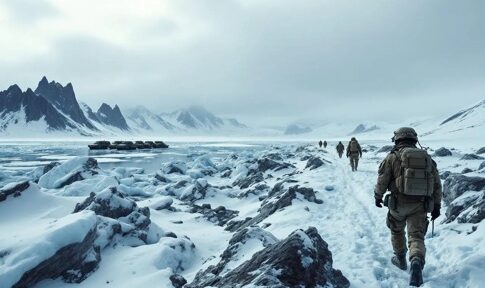
A long-buried Cold War “city under the ice” in Greenland is forcing new questions about secret government projects, nuclear waste, and who will clean up the mess.
Cold War “city under the ice” comes back into view
In April 2024, a NASA Jet Propulsion Laboratory team flew a Gulfstream III aircraft over northwestern Greenland to test a powerful new radar system called UAVSAR, designed to map layers within the ice sheet and the bedrock below. During that flight, the radar picked up a pattern of reflections matching man-made structures buried roughly 100 feet beneath the surface, lining up with historical maps of Camp Century, a Cold War U.S. Army base built in 1959 and abandoned in 1967.
Camp Century was publicly billed as a polar research station, complete with a hospital, theater, chapel, and living quarters for around 100 to 200 personnel, all housed in more than twenty snow-covered tunnels carved into the ice. Behind that scientific façade, however, the site served as a testbed for Project Iceworm, a classified scheme to carve out a 52,000-square-mile tunnel network under the ice sheet, where up to 600 nuclear-armed missiles could be hidden and readied to target the Soviet Union.
Project Iceworm’s ambition and failure under moving ice
Project Iceworm envisioned a sprawling grid of rail lines and missile launch points buried in Greenland’s interior, with warheads moved constantly beneath the ice to keep adversaries guessing. Engineers hoped the ice would act like a natural shield and camouflage. As the project moved from concept to reality at Camp Century, however, they discovered that the ice sheet was far more dynamic than expected, warping and crushing tunnels faster than they could safely maintain them, undermining the project’s basic logic.
By the mid-1960s, deformation in the tunnels had grown so severe that sustaining long-term operations underground became impractical, and the massive missile grid never progressed beyond the demonstration phase. The camp’s small PM-2A nuclear reactor, installed in 1960 to supply power and heat, was removed by 1964, but not everything radioactive or hazardous went with it. Records and later research indicate that contaminated cooling water, diesel fuel, PCBs, sewage, and other wastes typical of mid-century military outposts remained behind in the ice when U.S. forces pulled out.
Abandoned waste and a changing climate collide
When Camp Century was shut down in 1967, U.S. planners assumed the ice sheet above it would remain permanently frozen, keeping every barrel, pipe, and sump entombed for eternity. Later declassification of Project Iceworm in the 1990s revealed that Denmark had not been fully informed about the nuclear dimensions of U.S. activities in Greenland, fueling political friction and questions over who would be responsible if anything ever went wrong. For decades, though, the site attracted more curiosity than immediate concern.
As climate science advanced, that changed. Studies in 2016 and beyond highlighted accelerating mass loss from the Greenland ice sheet and warned that previously stable regions could eventually see enough melt and flow changes to re-mobilize buried wastes. Camp Century sits in northwestern Greenland, a remote but strategically important area roughly 150 miles east of what is now Pituffik Space Base. Model projections suggest that, over time, meltwater could reach the buried structures, carrying radioactive isotopes, fuel residues, and other pollutants into surrounding ice and eventually toward the ocean.
https://twitter.com/RedpillDrifter/status/2008690380871471195
Environmental risk, accountability, and what comes next
So far, available evidence indicates the remains of Camp Century are still fully buried beneath about 100 feet of ice, and there is no clear proof that contaminants have already begun leaking at a large scale. Nonetheless, scientists and policy analysts describe the site as a future environmental governance problem. If warming continues on current trajectories, the combination of structural decay and ice melt could, over decades or beyond, expose tunnels and waste to surface processes and meltwater channels that flow toward marine ecosystems and, ultimately, fishing grounds.
Responsibility for that potential cleanup remains unsettled. The United States built and operated the base, Denmark retains sovereignty over Greenland, and Greenland’s self-governing authorities have a strong interest in protecting their environment and communities. Media coverage spurred by NASA’s new radar imagery has renewed pressure in Denmark and Greenland to clarify who bears legal and moral obligations for any remediation. For now, no formal trilateral plan for excavation or containment has been publicly agreed, leaving a secret Cold War project as an unresolved twenty-first-century challenge.
Sources:
NASA rediscovers a secret military base buried under Greenland’s ice sheet
Inside Camp Century, The Secret U.S. Military Base Buried Under Greenland’s Ice
NASA Radar Detects Abandoned Site of Secret Cold War Project in Greenland
Greenland’s ancient ice reveals ice-sheet retreat and sea-level risk
New View of the ‘City Under the Ice’
Past Greenland ice loss raises concerns for future warming
In other words… it’s another Maybe theory!!