

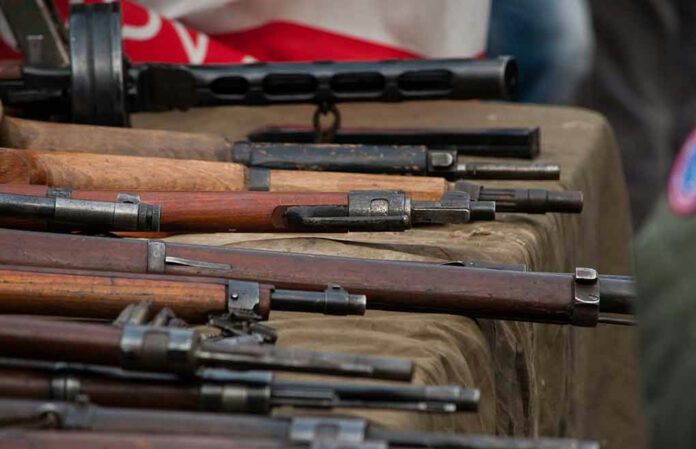
Federal law exempts muskets from 1776 and similar antique firearms from modern gun regulations, creating a striking legal paradox that reveals how America’s founding-era weapons escape the licensing, registration, and background check requirements imposed on contemporary firearms.
The Federal Exemption: How 250-Year-Old Weapons Escape Modern Gun Laws
Federal law defines “antique firearms” as weapons manufactured before 1899 or replicas using black powder and percussion cap ignition systems. These weapons are exempt from National Firearms Act registration requirements and do not trigger federal background check mandates. The Brown Bess musket, the primary firearm used by American Revolutionary forces, falls squarely within this exemption category. This means individuals can acquire, possess, and use historically accurate 1776-era muskets without any federal licensing, registration, or background verification process.
The regulatory framework stems from the National Firearms Act of 1934 and the Gun Control Act of 1968, which established modern federal firearms regulations. However, when these laws were drafted, lawmakers carved out exemptions for antique weapons, reasoning that pre-1899 firearms posed minimal regulatory concerns. The 1986 Firearms Owners Protection Act further refined these definitions, cementing the exemption for black powder replicas that authentically recreate Revolutionary War-era weapons.
Colonial America’s Mandatory Gun Ownership: A Forgotten Foundation
The contrast between colonial America’s approach to firearms and today’s regulatory landscape reveals a fundamental shift in how government views gun ownership. Most colonies required male citizens aged 16 to 60 to own functional firearms and maintain them in serviceable condition. New Hampshire mandated this requirement in 1716, Delaware required all freeholders and taxable persons to bear arms, and North Carolina included muskets worth at least 20 shillings as part of freedom dues for newly freed servants.
Massachusetts went further, establishing specific standards for militia weapons in 1645, requiring “full musket boare, or basterd musket” with minimum lengths of 3 feet 9 inches. Religious exemptions existed for groups like Quakers, who could avoid firearm ownership requirements by paying a fee. This regulatory approach prioritized widespread civilian gun ownership as essential to community defense and individual liberty, a principle embedded in the Second Amendment’s text.
The Regulatory Gap: When Historical Weapons Escape Modern Restrictions
The federal exemption creates a regulatory paradox. Modern semi-automatic rifles face extensive licensing, registration, and background check requirements at both federal and state levels. Yet a fully functional Brown Bess musket—capable of accurate fire at considerable distances—can be purchased without any background verification or government notification. This gap reflects how federal law prioritizes the age and mechanical design of a weapon over its actual functional capability.
States have responded with varying approaches to this federal exemption. Some states, including California and New York, have implemented additional state-level requirements for antique firearms, particularly those maintained in functional condition. Other states follow the federal exemption more closely, imposing minimal restrictions on pre-1899 weapons or their replicas. This state-by-state variation creates an inconsistent regulatory landscape where the legal status of an identical musket depends entirely on geography.
Stakeholders Divided: Preservation Advocates Versus Regulatory Advocates
Historical reenactment communities, antique firearm collectors, and black powder shooting sports organizations support maintaining broad exemptions for antique weapons. These groups argue that exemptions enable legitimate historical preservation, educational demonstrations, and recreational pursuits that connect Americans to their Revolutionary heritage. Museums and historical sites rely on these exemptions to maintain functional collections for public education. The economic impact is substantial, with reenactment tourism and antique firearm markets generating hundreds of millions in annual activity.
Gun control advocacy organizations and urban policy advocates counter that exemptions create potential loopholes in the regulatory framework. They argue that functional antique weapons pose comparable risks to modern firearms and that regulatory gaps should be addressed through legislative action. Law enforcement agencies note that enforcement challenges arise primarily when modern replicas are marketed as “antique” to circumvent regulations, rather than from legitimate historical weapons or collector activities.
Muskets like those from 1776 are mostly exempt from today’s gun laws https://t.co/hacsUM2JVv pic.twitter.com/ii771wL5SX
— The Independent (@Independent) May 14, 2026
The debate reflects broader disagreements about how federal government should balance historical preservation, constitutional rights, and public safety concerns. Supporters of broad exemptions contend that the federal framework appropriately distinguishes between weapons designed for 18th-century warfare and modern firearms. Critics argue that functional capability, not manufacture date, should determine regulatory status. This fundamental disagreement about regulatory philosophy will likely intensify as 3D printing technology and modern replicas blur the line between historical weapons and newly manufactured firearms.