

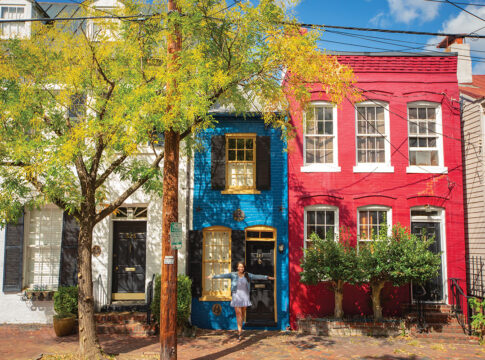
In the year 1830, a brickmaker named John Hollensbury was a man with a “handsome” two-story home and a very specific, very persistent problem. Located in the heart of what we now call the Old Town district of Alexandria, Virginia, Hollensbury’s property sat adjacent to a public alleyway roughly 7.5 feet wide.
While an alleyway might seem like a minor detail, to Hollensbury, it was an engine of constant irritation. Horse-drawn carriages, attempting to navigate the narrow shortcut, frequently miscalculated the turn, leaving deep gouges and scrapes in his exterior brickwork. When it wasn’t the noise and damage of the traffic, it was the “riffraff”—loiterers who found the shaded, secluded passage a perfect place to linger.
Hollensbury’s solution was a masterclass in nineteenth-century pettiness. He didn’t build a fence or a gate; he decided to “take away” the alley entirely by filling the void with a house.
A Tiny Masterpiece of Petty Revenge
The resulting structure, famously known as the Alexandria Spite House, is one of the most celebrated examples of “spite architecture” in America. Unlike traditional homes built to provide shelter or create beauty, this house was built primarily to obstruct.
Despite its spiteful origins, the house is a marvel of efficiency and surprisingly functional. Because the space was so tight, Hollensbury bypassed traditional construction methods. He didn’t build new side walls for the structure; instead, he simply used the existing exterior brick walls of his own house and his neighbor’s house as the interior walls of the new residence. To this day, if you step inside the living room, you can still see the distinct gouges and scuff marks left by the carriage wheels of the 1820s—permanent scars of the annoyance that birthed the building.
Life Inside the Seven-Foot Squeeze
While the home is only 7 feet, 6 inches wide, it stretches roughly 25 feet back into the alley, offering a total of 325 square feet of living space spread across two floors.
- The Ground Floor: Features a cozy (if narrow) sitting area and a tiny, functional kitchen.
- The Upper Floor: Houses a small bedroom and a surprisingly well-appointed bathroom, complete with a classic clawfoot tub.
The house is more than just a novelty; it is a liveable home. Its creature comforts are substantial enough that it has been used as a primary residence for decades at a time. One couple lived in the “alley-house” for 25 years, proving that while the house was born of a desire to keep people out, it is quite good at keeping people in. Its value has also skyrocketed; while the most recent owner purchased it in 1990 for $130,000, its modern assessed value is over $661,000, making it some of the most expensive “spite” in history.
New York’s Five-Foot “View-Blockers”
Alexandria wasn’t the only place where property disputes led to architectural oddities. In 1882, New York City developer Joseph Richardson found himself in a high-stakes game of bluff with a neighbor.
Richardson owned a sliver of land on 82nd Street that was just 5 feet wide and 100 feet long—a result of the city’s grid system cutting through odd-shaped lots. When the owners of the adjacent lot began building an apartment complex, they offered Richardson $1,000 for his “useless” strip of dirt. Richardson countered with $5,000.
The neighbors refused to pay, laughing off the demand because they believed nothing could possibly be built on a lot only five feet wide. They assumed their residents would enjoy unobstructed views forever. Richardson, fueled by a desire to prove them wrong, built two 5-foot-wide, 50-foot-long houses directly against their building, effectively “walling in” their windows and ruining their property value. Richardson even moved into one of the units himself to enjoy the fruits of his labor until his death in 1887. Though these New York spite houses were eventually demolished in 1915, they remain a legendary chapter in the history of Manhattan real estate.
Sources:
The Trump Administration’s 2025 Changes to Immigration Law …
The First 100 Days of the Second Trump Administration
The Anti-Immigrant Policies in Trump’s Final “Big Beautiful Bill …
Protecting The American People Against Invasion – The White House