

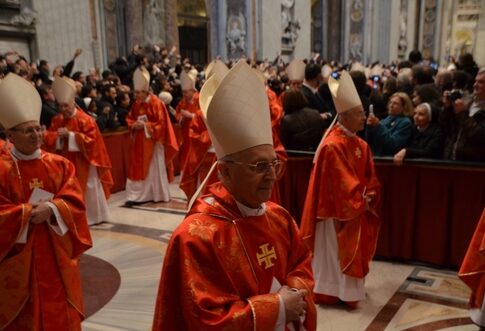
Pope Leo XIV confronts his first major crisis as a traditionalist Catholic group defies Vatican authority by planning unauthorized bishop consecrations, threatening to reignite a schism that could fracture the Church just as his papacy gains momentum.
Traditionalists Challenge Vatican Authority With Unauthorized Consecrations
The Society of St. Pius X announced in early February 2026 its intention to consecrate new bishops on July 1 without papal approval, citing “grave necessity” to preserve Catholic tradition. Father Davide Pagliarani, the group’s superior general, sent a letter to Pope Leo XIV explaining that aging SSPX bishops can no longer meet global demands, but received what the organization deemed an inadequate Vatican response. This unilateral move directly challenges canonical law requiring papal consent for bishop consecrations, a cornerstone of apostolic succession that the Vatican views as non-negotiable for maintaining Church unity.
Vatican spokesman Matto Bruni responded cautiously, stating that “contacts continue to avoid rifts or unilateral solutions,” signaling Rome’s preference for dialogue over confrontation. The planned consecrations would trigger automatic excommunication under canon law, mirroring the 1988 crisis when SSPX founder Archbishop Marcel Lefebvre consecrated four bishops without permission. However, unlike that clear act of defiance, this crisis unfolds after Leo XIV extended olive branches to traditionalists through limited Latin Mass exceptions, making the SSPX’s decision particularly problematic for a pope attempting to balance competing factions within the Church.
Decades of Vatican II Resistance Fuel Current Standoff
The conflict’s roots trace to the 1960s Vatican II reforms that transformed Catholic worship from traditional Latin Mass with priests facing altars to vernacular services emphasizing congregational participation. SSPX was founded to resist these changes, establishing a global network of chapels, schools, and seminaries operating outside regular Church structures. Pope Benedict XVI attempted reconciliation in 2009 by lifting excommunications of surviving bishops and easing Latin Mass restrictions, but the effort collapsed when SSPX Bishop Richard Williamson’s Holocaust denial sparked international outrage, demonstrating the challenges of reintegrating traditionalists without doctrinal compromises.
I am 100% certain the Catholic Church will suffer a major schism soon. It will dwarf the Protestant Reformation. I don’t think it will happen under this pontificate. I believe it will happen under a future (more conservative) pope. The religious Left (Modernists) in the Church… pic.twitter.com/51wTk23AZp
— Shane Schaetzel †☧ (@ShaneSchaetzel) November 15, 2023
Pope Francis reversed Benedict’s accommodations, restricting the Latin Mass as divisive and reinforcing Vatican II’s legitimacy. This created the environment Leo XIV inherited upon his election around early 2025. While Leo has shown openness to dialogue and granted some Latin Mass exceptions, SSPX leadership argues these gestures fall short of addressing what they frame as the spiritual needs of souls seeking traditional worship. The group operates irregularly but continues growing, creating a de facto parallel structure that Vatican officials fear could solidify into permanent schism if unauthorized consecrations proceed, enabling SSPX to ordain priests independently of Rome indefinitely.
Leo XIV’s Balancing Act Between Reform and Tradition
Pope Leo XIV has positioned himself as a “revolutionary of deceleration,” continuing Francis’s progressive trajectory on bishop appointments and synodality while slowing reforms to Vatican banking and canon law. His 2026 agenda includes a crucial consistory on cardinal governance that emphasizes episcopal discernment over democratic lay participation, a stance that neither fully embraces traditionalist demands nor satisfies progressive calls for church democratization. This middle path leaves Leo vulnerable to criticism from both camps, with the SSPX crisis exposing the limits of his diplomatic approach when traditionalists perceive dialogue as insufficient action to preserve doctrinal integrity.
A good infographic for those who would claim that the Popes have declared Our Venerable Clergymen as being Schismatics. pic.twitter.com/Rf7XWxzSEJ
— Patrick ‘the Penitent’ (@brotherpat777) January 30, 2026
The timing compounds Leo’s challenges, as Europe faces demographic decline, rising secularization, and what some Catholic observers describe as Islamization pressures alongside EU centralization eroding subsidiarity principles. In this context, internal Catholic division over liturgy and authority weakens the Church’s ability to address external threats to traditional values including legalized euthanasia, abortion expansion, and family structure erosion. Experts warn that if the Vatican appears to accommodate every faction through pastoral flexibility rather than maintaining doctrinal clarity, it risks becoming irrelevant precisely when Western civilization needs moral leadership. The SSPX consecrations would mark a visible fracture, undermining papal authority at a moment when unity is essential.
Schism Threat Carries Long-Term Consequences for Church Unity
If SSPX proceeds with July 1 consecrations, automatic excommunications would deepen the division, potentially fragmenting traditionalist communities between those willing to remain in irregular communion and those seeking full Vatican reconciliation. Short-term impacts include heightened confusion among SSPX’s global priests, nuns, and lay faithful about their canonical status and sacramental validity. Long-term consequences are graver: a parallel church structure with independent apostolic succession claims would resurrect the 1988 precedent on a larger scale, as SSPX has grown substantially over nearly four decades. This threatens to normalize schism as an acceptable option for Catholics dissatisfied with Rome’s direction.
Liberal Catholicism is dying, and it will eventually go extinct. When I say “liberal,” this is what I mean…
1. Heretical — seeking such things as female ordination and blessing of same-sex relationships.
2. Putting a greater emphasis on social justice rather than the core… pic.twitter.com/VUIGQtjSm9— Shane Schaetzel †☧ (@ShaneSchaetzel) July 28, 2025
The crisis also tests whether Leo XIV’s papacy can effectively govern a Church increasingly divided along liturgical and doctrinal lines. Analysts view 2026 as pivotal for his agenda, with the upcoming consistory representing a decisive moment for redefining cardinal governance amid these tensions. For traditionalist Catholics who value reverence, doctrinal stability, and preservation of historic worship forms, the standoff represents justified resistance against what they perceive as abandonment of tradition in favor of modernist compromises. The question remains whether Vatican negotiations can produce a resolution satisfying SSPX’s concerns without surrendering the principle of papal authority over bishop consecrations—a principle rooted in Scripture and maintained for two millennia as essential to Catholic ecclesiology and Church unity.
Sources:
Will 2026 be a crucial year for Leo and the Catholic Church? – Kritik Bakis